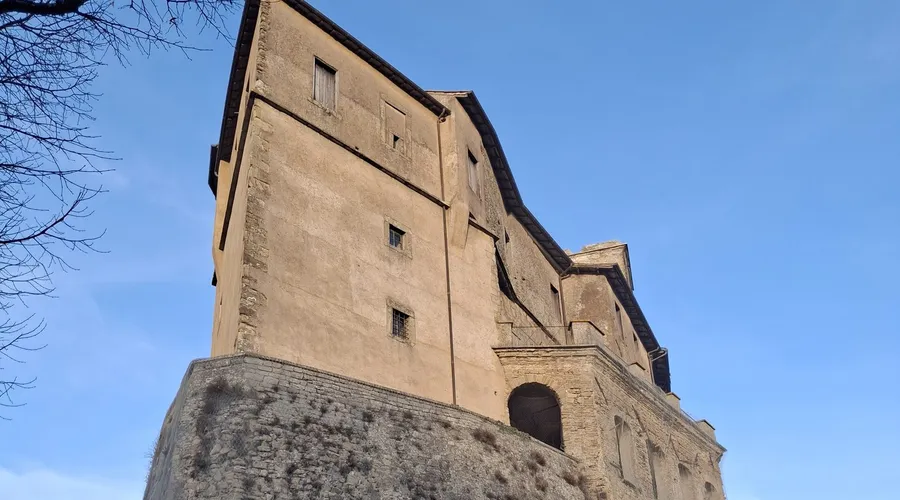
The site on which the castle stands was probably occupied as early as the high Middle Ages: according to tradition, it was in the 9th century, following Saracen raids, that the inhabitants of the surrounding areas took refuge on the rocky outcrop, giving rise to the new fortified settlement around which the village developed. A document from 1085, preserved in the Regesto Sublacense, records the donation of some lands to the Monastery of Subiaco — the earliest certain attestation of the “castrum Sancti Viti” and evidence of the control exercised by the Benedictine monks over the area. Around 1180 the fief passed to the powerful Colonna family, who enlarged the stronghold and strengthened its defences, making it the centre of feudal power over the territory; Colonna rule continued until the 16th century, when the family’s financial difficulties made the sale of the fief necessary. According to some historians and local tradition, Pope Martin V — born Oddone Colonna, elected pontiff in 1417 — was born within these very walls: the claim, which fits within the period of Colonna rule, nonetheless remains a matter of debate and should be regarded as a historical tradition rather than an established fact.
In 1563 the Colonna sold San Vito to the Massimo family, who around 1575 passed it on to the Theodoli marquises, still the owners of the castle today (not to be confused with the identically named Theodoli Castle in Sambuci). It was Gerolamo Theodoli, Bishop of Cadiz, who acquired the lordship of San Vito together with the holdings of Ciciliano and Pisoniano; in 1592 Teodolo Theodoli took the title of first Marquis of San Vito, opening the long season in which the family did not merely hold the fief but helped reshape the village and its urban layout.
It was Cardinal Mario Theodoli, born in 1601, who promoted — from around 1640 — the construction of “Borgo Mario”, built on an artificial terrace beside the fortress to expand the old medieval centre beyond the limits imposed by the rocky outcrop: new streets were opened and major building work undertaken, including the church of Santi Sebastiano e Rocco and the adjoining Carmelite convent. Mario died in 1650 before the programme was completed, and the work was carried on by his nephew Carlo Theodoli, to whom the building owes its present appearance: the distinctive ship-like shape with its “prow” jutting towards the main street, the loggia, the exedra-shaped access ramps and the Guelph battlements crowning the top. In the 18th century the family continued to leave an important mark on the area, and among its members Gerolamo Theodoli (1677-1766), architect and Marquis of San Vito, also known for his architectural work in Rome, stood out.
The interiors, closed to the public as they remain the private residence of the Theodoli family, house frescoes and decorations partly attributed to the painter Crescenzio Onofri. The arched loggias look out over Corso Mario Theodoli, while the main entrance, at the back of the building, faces the Church of Santa Maria de Arce. With its imposing mass and scenic position, the castle remains the most recognisable image of San Vito Romano, visible from the outside from many points around the village.