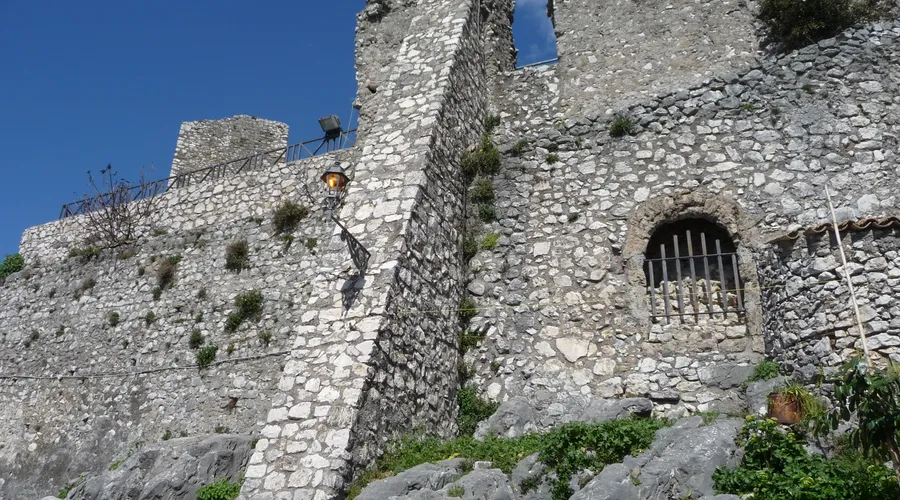
Olevano Romano, a village perched on a rocky spur not far from San Vito Romano, has origins going back at least to Roman times, attested by stretches of polygonal-masonry walls still visible today. Having become a castrum in the Middle Ages, the village appears in 1232 in a deed between Oddone Colonna and Pope Gregory IX: it is from this family that the Colonna-Barberini Castle takes its name, built to defend the settlement and passed down over the centuries through the Colonna, the Comune of Rome, the Orsini and finally the Borghese family, down to its last lord, Camillo Borghese, husband of Pauline Bonaparte.
But it is in the 19th century that Olevano gained a very particular fame, becoming a destination for over a thousand European painters - German, Danish, English, French - for whom the journey to Italy was an essential step in their landscape training. Among the first to arrive was the Tyrolean Joseph Anton Koch, followed by Franz Horny, Friedrich von Olivier and, later, Jean-Baptiste Camille Corot, who stayed here in 1826-27 and painted the surrounding countryside. These artists, known as the “Nazarenes” and later as the Deutschrömer (“German Romans”), found their favourite subject in the nearby Serpentara woodland, an oak grove growing on bare rock whose wild charm, all twisted trunks and exposed roots, lent itself perfectly to landscape study.
When in the 1870s the wood risked being cleared and commercially exploited, the German artistic community raised funds to buy it and in 1873 donated it to the German state to protect the landscape that generations of painters had portrayed: a gesture that still today makes the Serpentara Nature Reserve, roughly 94 hectares of centuries-old oaks, a patch of Italian territory owned by Germany - a unique case of its kind.
Still today the castle dominates Olevano’s historic centre, while the Serpentara, with its namesake villa, remains a destination for walks and for the same wild charm that captivated Romantic painters two centuries ago.
Opening hours and contacts
Civic Art Museum (Villa De Pisa)
The civic museum, in Villa De Pisa, holds works by the painters who portrayed Olevano and its landscape:
- Wednesday, Thursday and Friday: 9:00 am – 1:00 pm;
- Saturday and Sunday: 9:00 am – 1:00 pm and 3:30 – 7:00 pm.
Booking is recommended at weekends.
Email: museo_civico@comune.olevanoromano.rm.it
Address: Viale Vittorio Veneto 25, Olevano Romano (Rome)
Colonna Castle and the Serpentara
We have not found published visiting hours for the castle or for the Serpentara wood: the old town can be explored freely on foot, while for visits it is best to ask the museum for information.
Opening hours may change: it is best to check them before setting off.
Source for the museum’s opening hours and contacts: AMO - Associazione Amici del Museo di Olevano Romano (checked in October 2026).
Photo: Pietro Scerrato, Wikimedia Commons, CC BY 3.0; Paul Weber, public domain; Kaethe17, CC BY 4.0.