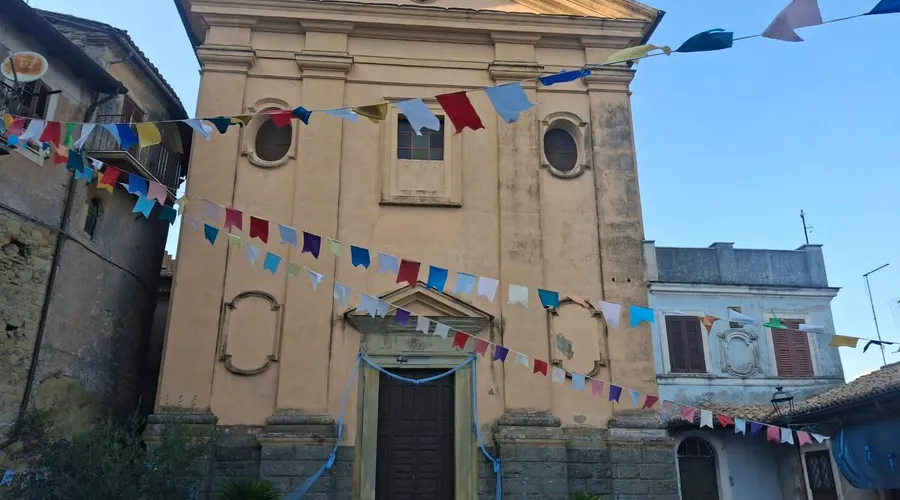
Piazza San Biagio is one of the hearts of San Vito Romano’s old town: a small square paved in cobblestones, overlooked by the parish church of San Biagio Vescovo e Martire, which stands at the centre of the network of alleys and stairways that make up the town’s medieval core. The church’s construction date is uncertain: tradition holds that it was built on the site of an earlier 12th-century oratory. The present building is the result of the rebuilding promoted by the Theodoli family between 1607 and 1609, to a design by the architect Giovanni Theodoli. The square itself was redeveloped in 1646, and the church was formally consecrated on 13 October 1777.
The Baroque interior houses, above the high altar, an early 17th-century fresco (possibly from 1609) by an unknown late-Mannerist artist of the Roman school, depicting Saint Blaise saving a child from a fishbone stuck in his throat, together with a woman. This is the miracle behind the saint’s cult as protector of the throat: every year, on 3 February, the tradition of the blessing of the throats is renewed.
In the 19th century the two chapels of the Rosary and of Saint Joseph were added on either side of the presbytery, in 1831 and 1847 respectively. The first restorations, in the early 20th century, heavily altered the original quality of the frescoes: of the old painted decoration, some frescoes by an unknown artist with various figures of saints survive in the side chapels, completed and retouched by Antonelli around 1928. Between 1927 and 1929 the interior was also enriched with marble altars and new flooring. Also worth noting is the 17th-century baptismal font, made up of a porphyry basin topped by an opening tabernacle in painted and gilded walnut.
By day the square is a quiet crossing point among the alleys of the old town; in the evening, with the streetlamps lighting up the stone façades, it becomes one of San Vito Romano’s most evocative corners, especially during festivals, when it fills with colourful bunting.