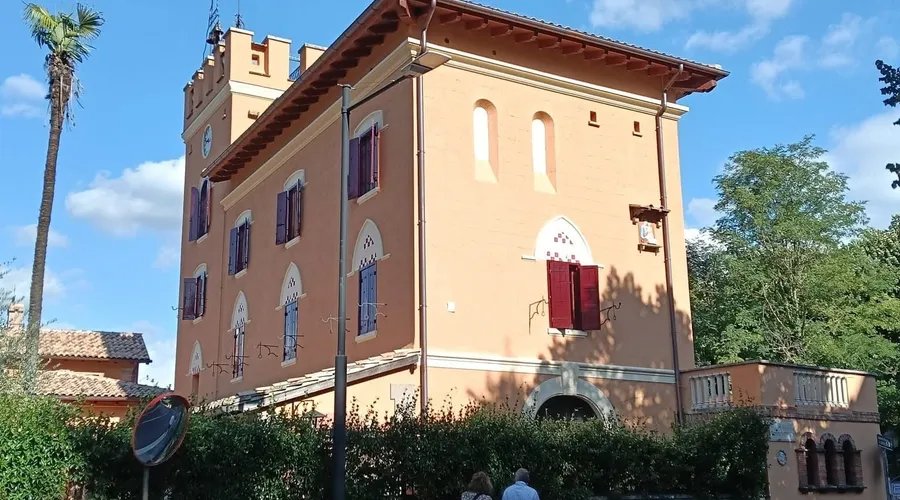
Villa Castellini is one of the historic and prestigious manor houses of San Vito Romano, part of the rich heritage of villas and stately residences that, between the 19th and 20th centuries, helped give the town its distinctive character as a place of summer retreat and residence for wealthy families and prominent figures.
The presence of the Castellini family fits into a social context of particular importance for the modern history of San Vito. The Municipality in fact remembers the Castellini, alongside the Theodoli, Baccelli and Ivella families, as one of the families that enlivened the town’s cultural and social life during the 20th century. The Municipality particularly remembers the notary Paolo Castellini, a member of the family and a prominent figure, associated by local sources with the complex network of political and social ties that linked the town’s leading families.
The link with the Baccelli family is just as significant. The Baccelli family, originally from Florence, settled in San Vito in the 17th century and gradually became part of the circle connected to the Theodoli. From this line also descended Guido Baccelli, physician, university professor and politician, whose villa stands right next to Villa Castellini. The two residences are therefore a particularly interesting testimony to how some of the most important families of 19th- and 20th-century San Vito were concentrated in this part of town.
Along the road that runs through the town, a crenellated tower with a clock, bells and a rooster weathervane announces the villa, which stands out for its distinctive Neo-Gothic style. The building, painted in warm pink tones, features arched windows with chequered decorations, colourful shutters and a small brick wing topped by a bell tower with a cross. The whole creates a deliberately theatrical architecture, in which residential, decorative and almost fairy-tale elements blend in an original way. Regional tourist documentation in fact lists Villa Castellini among the historic villas of San Vito and explicitly identifies it as a Neo-Gothic villa.
Beyond the courtyard, overlooked by an arched portico, lies a charming park adorned with statues and fountains, descending in terraces along the slope. As it appears today, tree-lined avenues shaded by lime trees, cypresses, cedars and pines alternate with stone stairways, box hedges and brick pillars topped with flower pots. In the middle of a clearing stands a fountain with a round basin covered in water lilies and a sculpture of dolphins holding up a bowl, while on a terrace potted roses frame a row of ancient columns. From the more open spots in the park, the view reaches the historic centre and Theodoli Castle.
The garden is not merely an accessory to the villa but a fundamental part of its architectural identity. A local description of the villa credits the care of its owner, Paolo Castellini, for the wealth of statues, fountains and ornamental details in the complex, also recalling his search for water springs on the grounds to feed the fountains.
The villa’s location is also particularly significant: it lies in the part of San Vito where, over time, several residences of illustrious families were built. Villa Guido Baccelli is adjacent to Villa Castellini, while other historic residences, such as Villa Augusto Baccelli and the Villino Ivella and Villino Pacini, complete the town’s ensemble of historic villas.
The villa’s story is also intertwined with the more dramatic events of the 20th century. A testimony collected as part of the “Memoria e Territorio” (Memory and Territory) project, dedicated to the memories of San Vito’s inhabitants during the Second World War, recounts that after the war some displaced people occupied Villa Castellini, along with other buildings in town, because they had been left homeless. It is an oral testimony and should therefore be kept distinct from historical and administrative records, but it is an interesting memory of the role the villa played in a period very different from the one for which it was originally conceived.
The villa is private property and is not normally open to the public. Over the years, however, it has been included in itineraries dedicated to discovering the historical and artistic heritage of San Vito Romano, a sign of the interest the complex continues to attract.
A particularly significant opening took place on 13 September 2025, when Villa Castellini exceptionally opened its doors for the event “100 Anni di Rintocchi” (100 Years of Chimes). The cultural and charity initiative allowed the public to enter the residence and rediscover its architecture and historical heritage.
On that occasion the villa appeared in all its charm, revealing a carefully preserved and enhanced residence. For the people of San Vito it also remains a place closely tied to the town’s memory and to its present-day social life. The theatrical character of the villa and its park has also made it an evocative setting for wedding photos and photo shoots.
Villa Castellini is therefore more than just a historic residence: it is a testimony to the social, architectural and landscape history of San Vito Romano, closely linked to the families who contributed to the life of the town and to the development, between the 19th and 20th centuries, of its role as a place of residence and summer retreat.